A keelboat that flies
Ferrari’s Hypersail foils on three points of contact, and generates the power it runs on. First-hand from Maranello.
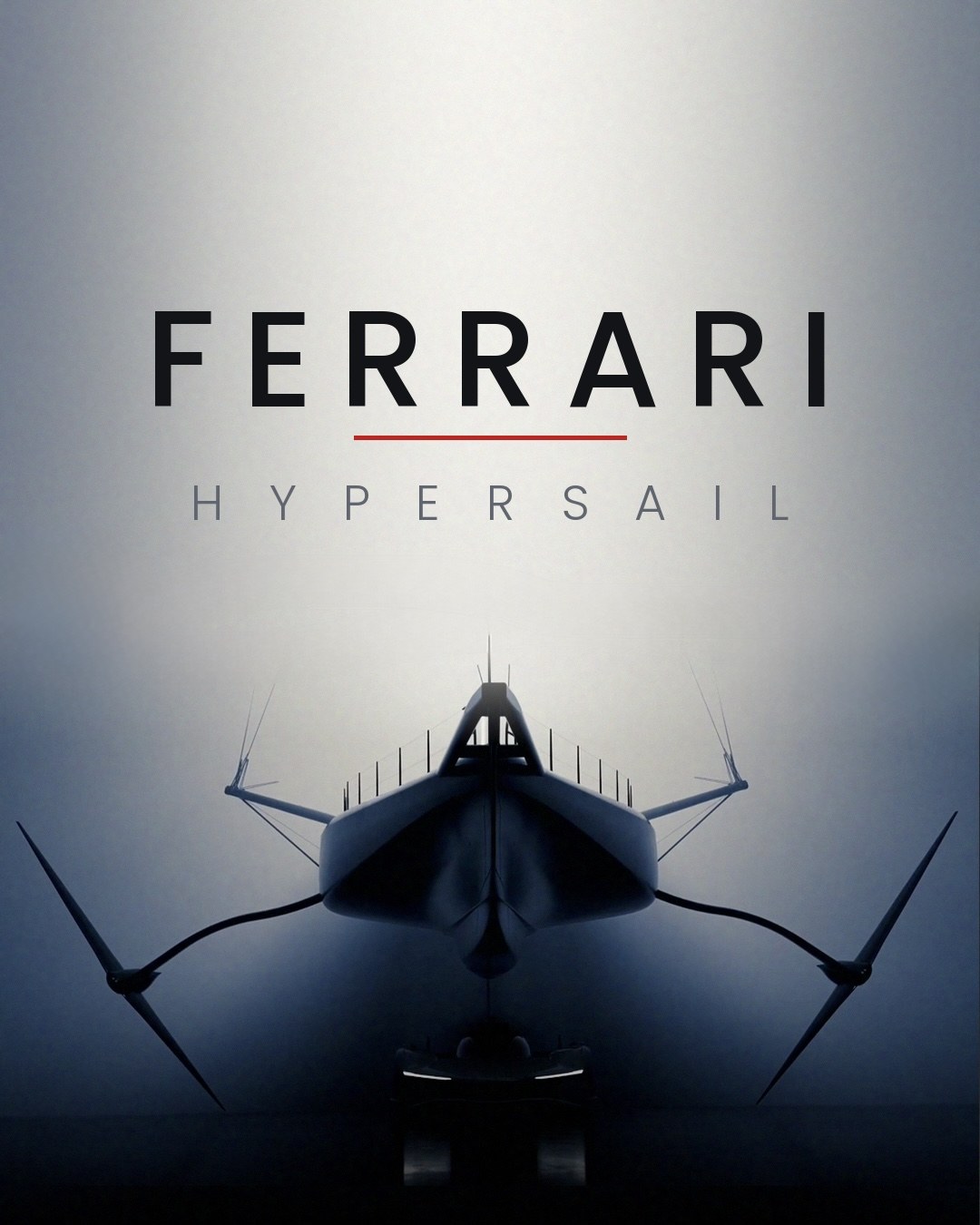
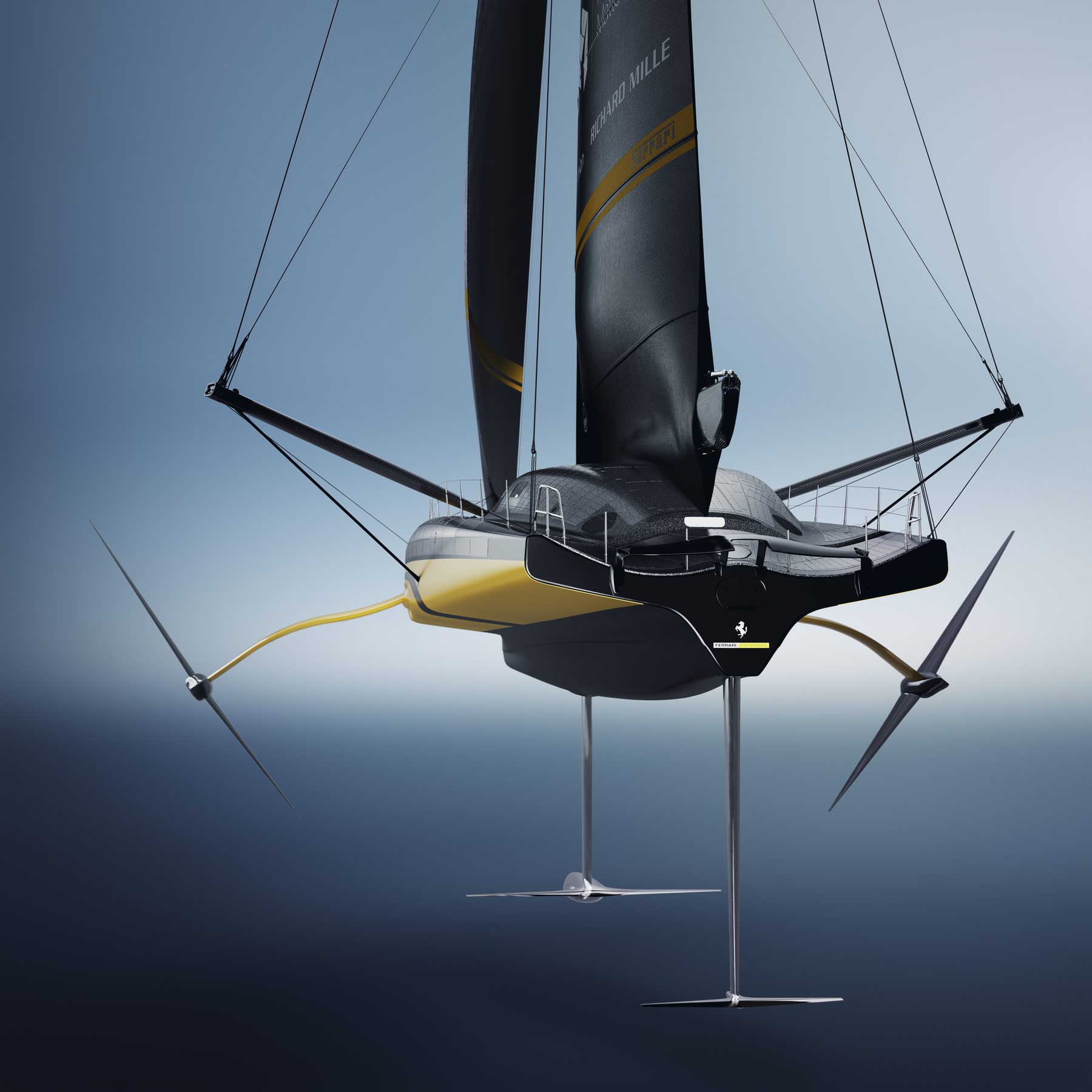
Most foilers fly on two points of contact. Ferrari's Hypersail has three: a main T-foil on curved arms, a rudder, and a horizontal wing beneath the canting keel, which still carries a lead bulb because the boat has to be safe offshore. Ferrari describes her as the first fully foiling monohull for offshore racing.
The third point is the whole argument. Two-point foilers trade stability for speed and are happiest inshore, on a course, with a chase boat in sight. A keel that still carries ballast is the opposite instinct: it is what lets a boat look after itself when the weather arrives.
Putting a lifting wing under that keel, rather than removing the keel altogether, is an attempt to have both, and it is the reason this hull is 100 feet of carbon rather than a scaled-up dinghy. Guillaume Verdier leads the design and the project is sailed by Giovanni Soldini, whose offshore record is why the brief reads the way it does. The hull came out of its mould in Pisa in May, and launch is expected late in the year. This is a boat meant to be taken somewhere, not simply timed.
The boat makes its own power
In July, Ferrari unveiled the part of the project that is easiest to overlook and hardest to do. Hypersail is designed for complete energy autonomy: every adjustment aboard, above deck and below, is powered by energy the boat generates while it is sailing.
The system was developed by the Hypersail Tech Team in Maranello, where the technology and the design work sit, with two objectives held at once: maximum efficiency and the total integration of the various onboard architectures. Ferrari is explicit about why it went electric: a boat facing long-distance passages has to be self-sufficient, and that requirement drove the design toward harvesting as much as it can from its surroundings.
“Hypersail is the first foiling monohull for ocean racing to achieve complete energy autonomy. Thanks to an electrical system that ensures the ideal balance between efficiency and performance, alongside innovative solutions such as Winch-by-Wire, all on-board adjustments are powered entirely by energy generated while underway.”
Marco Guglielmo Ribigini, Technical Team Leader, Ferrari HypersailAbove deck: winch by wire
The crew are part of the power system. On a conventional yacht a grinder's effort drives mechanical transmissions and hydraulic circuits directly. On Hypersail that effort is converted into electricity the instant it is made, centralised, and redistributed to whichever part of the sail plan needs it.
The gain is not raw output, it is cadence. In a conventional system, as resistance rises the movement inevitably becomes slower and more strenuous. Winch by Wire flattens that escalation, holding the grinder where electromechanical efficiency and human metabolic performance are both at their peak. Ferrari says the result lets a single crew member manage loads of up to nine tonnes.
The pedestals use the same electric motors found in the active suspension of the Purosangue and the F80, and the philosophy is the one introduced on the 12Cilindri Manuale, where a mechanical action becomes an electronic signal while the analogue feel of it survives intact. A road-car idea arriving at sea more or less unchanged is rarer than it sounds.
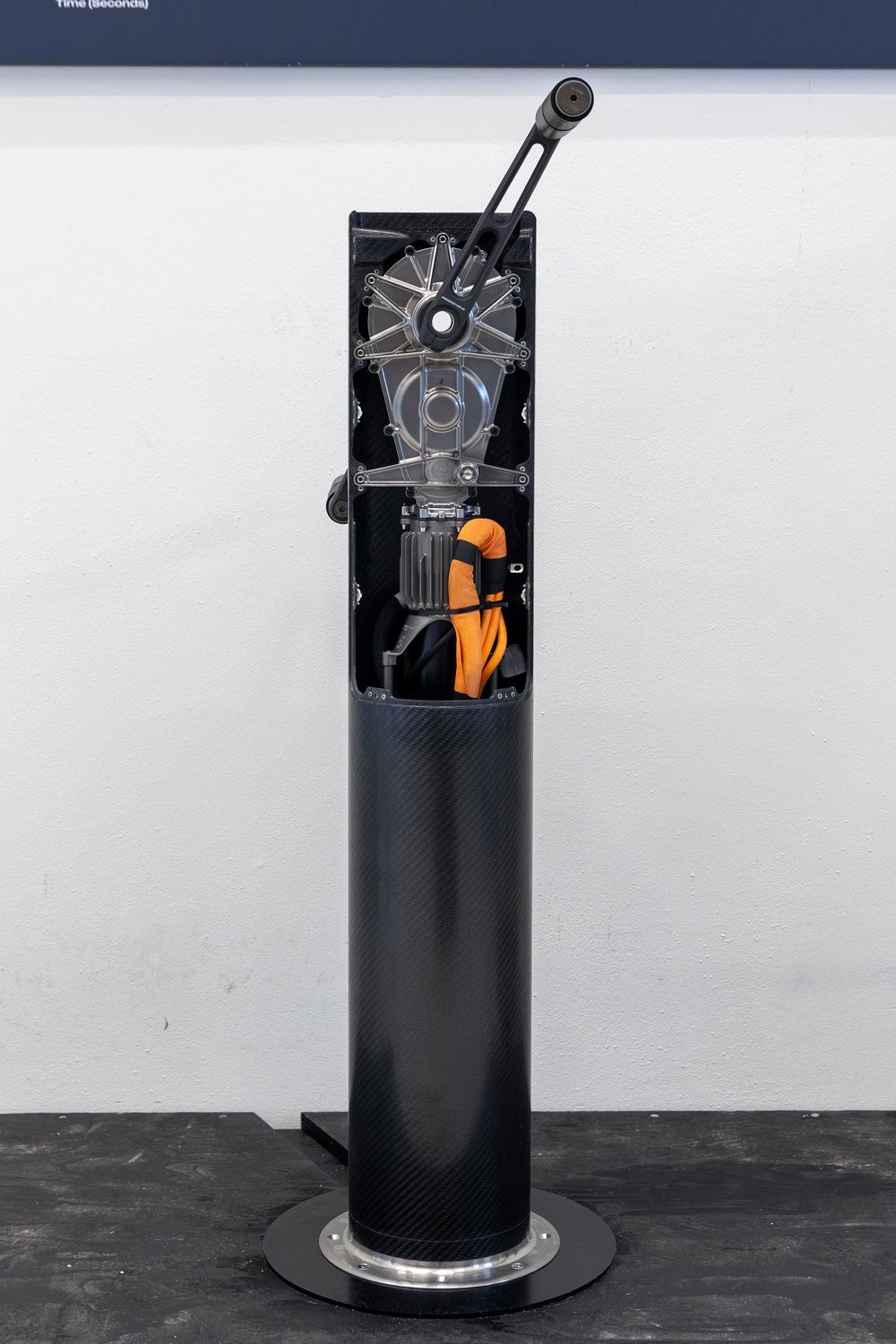 A pedestal, sectioned. The carbon column carries the same motor Ferrari uses in the active suspension of its road cars.
Below deck: flight control
Under the deck sits the part that keeps her flying: the electronics managing control stability and ride height on the foils, built on a platform of control units and sensors, tested to automotive process, and running four different voltage levels between 12 and 800 volts.
An active Flight Controller governs the appendages across two modes. Slow Movements are the macro-adjustments, the foil arms and the canting keel, powered by an 800-volt rear e-axle taken from Ferrari's road cars. Fast Movements are the constant small corrections of the flaps, handed to two smaller pumps on 48-volt motors. Splitting them that way buys efficiency and, more to the point offshore, redundancy.
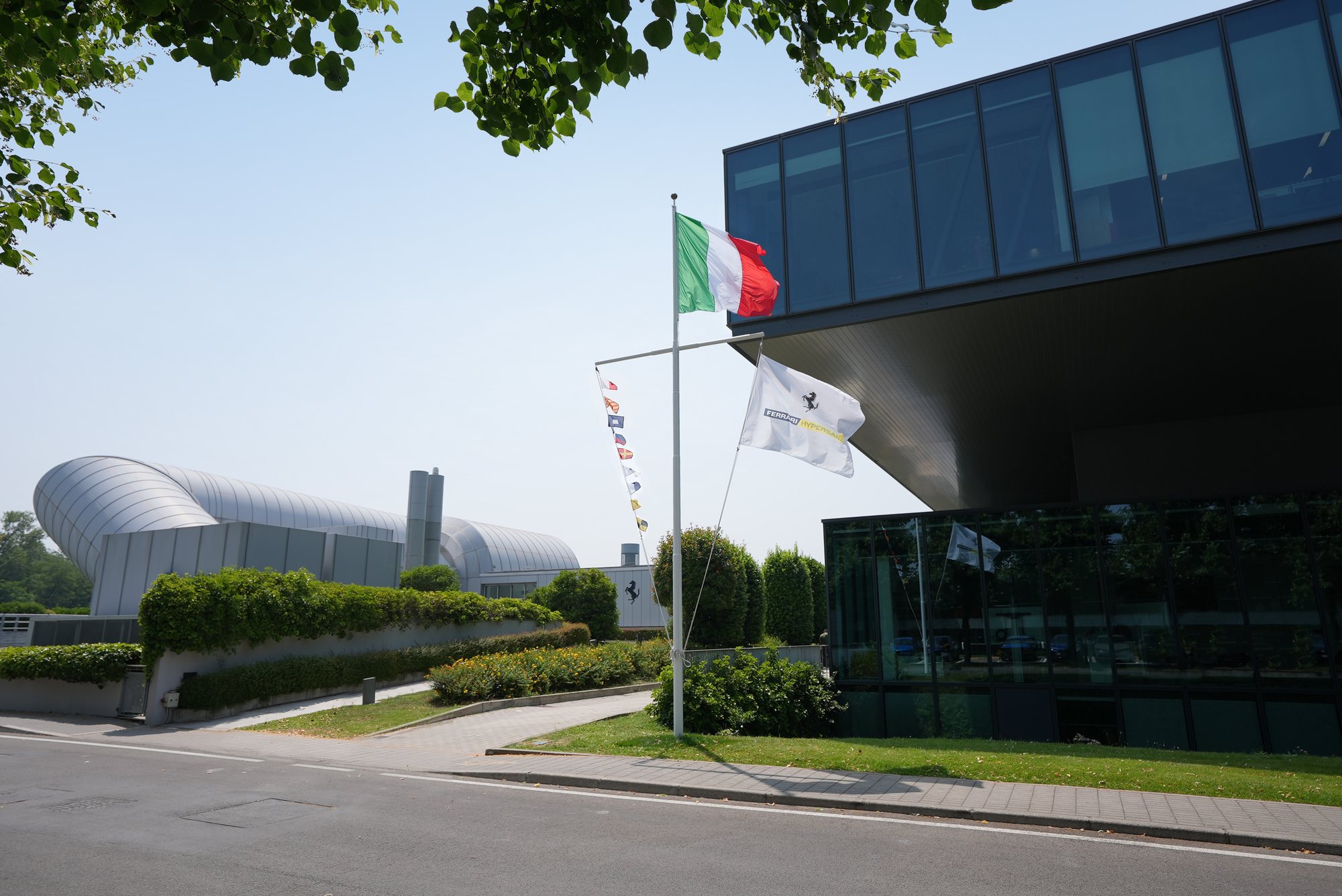 Maranello, July 2026. The Hypersail burgee alongside the tricolore at the gate.
Where the energy comes from
Roughly 100 square meters of solar is integrated into the deck and topsides. It is walkable, with a specific grip, and its placement is the product of simulations that mapped solar exposure across different latitudes and potential routes so that panels went only where they would earn their weight. On a boat where mass is the enemy, deciding where not to put something is the harder half of the job.
Wind turbines sit at the stern and can be configured or removed according to how she is being sailed, their intake angle studied for the balance between generation and aerodynamic drag at speed. Surplus energy is not dissipated: it goes into two identical 800-volt batteries and comes back out as the boat asks for it.
What is not yet known
No performance figures have been published, and she has not sailed. Ferrari frames the programme as pushing beyond the boundaries of sailing technology, with the focus on efficiency and performance rather than on a number. What is learned out there could find its way into future road cars; Ferrari puts that as a possibility, and so do we.
What makes this worth following is not the badge. It is that a company with nothing left to prove about speed has entered sailing through its most difficult door, at a scale where getting it wrong is expensive and public. Coverage continues as she nears the water.
Independent editorial. Sailyachts is not affiliated with the brands or organisations mentioned.
 CharterAll About U 2
 Design · 3 November 2026The world's first yacht-branded residences
 Design · 2 August 2026Why does fashion keep choosing sailing?
 Charter · 12 November 2026Onboard Maltese Falcon
 Regatta · 11 November 2026Sixty years on, Porto Cervo opens the season
 From the yard · 10 November 2026Sunreef is replacing the sail
 New build · 27 October 2026The Lagoon Eighty 2, and the case for owning one
 From the yard · 23 October 2026The wallywind110, and the saloon you can't see
 From the yard · 21 October 2026Aquarius, built twice